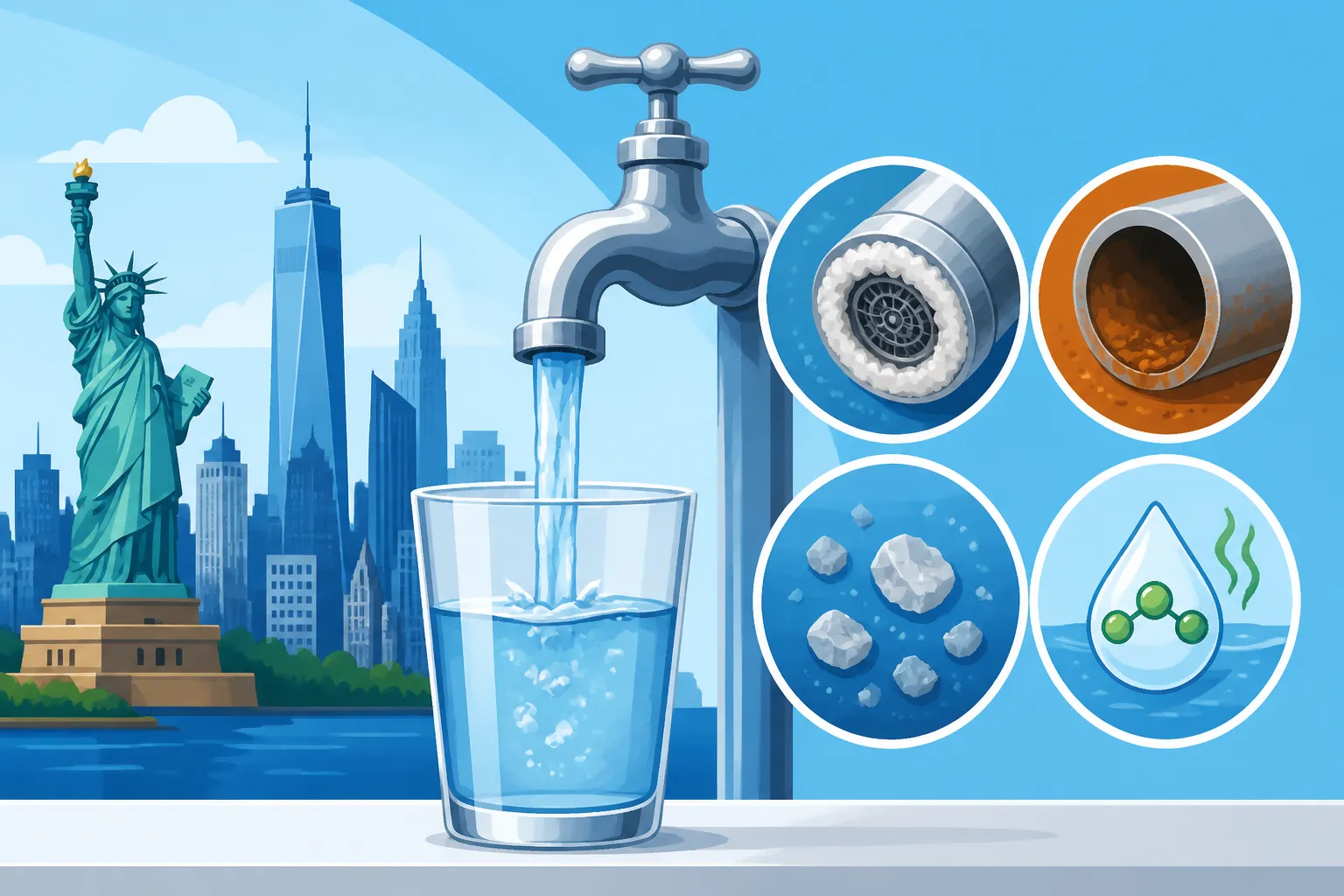
New York Tap Water Nuisances: Hardness, Scale, Rust and Chlorine Taste
New York tap water can leave scale on fixtures, make soap harder to rinse, run rusty-colored, or taste strongly of chlorine. These nuisances can come from the water supply, a building’s plumbing, or both. The useful first step is to identify which problem you have and where it starts; the right fix may be a simple cleaning or plumbing check, not a filter or softener.
What These Tap Water Nuisances Can Tell You
Hardness, scale, rust-colored water, and chlorine taste are noticeable, but they do not point to the same cause or call for the same response. New York water varies by supplier and source, and water can also change as it passes through a building’s pipes, fixtures, and water heater. A neighbor’s experience is a clue, not proof that your tap is affected in the same way.
| What you notice | Common possibilities | A useful first check |
|---|---|---|
| White or chalky deposits on fixtures | Hardness minerals left behind as water dries | Compare deposits across faucets and check whether they recur after cleaning |
| Soap that lathers poorly or spots on dishes | Hard water, detergent use, or a rinse-cycle issue | Look for scale on more than one fixture and review your appliance settings |
| Brown, orange, or reddish water | Disturbed sediment, corroded plumbing, or iron-containing material | Compare cold and hot taps; ask neighbors whether they see it too |
| A bleach-like or swimming-pool-like taste or smell | Disinfectant in the supply, a change in its level, or a building-specific issue | Compare cold water at several taps and check supplier updates |
| A problem limited to one faucet | Aerator debris, a fixture, or nearby plumbing | Remove and inspect the aerator if you can do so safely |
| A problem at every tap in the home | A supply issue, building plumbing, or equipment affecting the whole home | Ask neighbors and contact the water supplier if the change is sudden or persistent |
Hard water is water with more dissolved calcium and magnesium than soft water. Those minerals can leave deposits and affect how soap behaves. They are not the same thing as rust or a chlorine taste, and a softener is not a general-purpose filter.
Rust-colored water is an appearance, not a test result. Iron can cause orange or reddish staining, but color can also come from sediment or corrosion in plumbing. A discolored glass alone cannot show which substance is present or whether the water meets drinking-water standards.
Chlorine is commonly used to disinfect public water supplies. A chlorine-like taste may be more noticeable at some times or in some buildings, but taste alone does not establish whether water is safe or unsafe. Check the supplier’s current notices and report if a sudden change persists. The report and the tap answer different questions; see Does a New York Water Quality Report Describe Your Own Kitchen Tap?.
If the problem is new, getting worse, or accompanied by an official notice, treat it differently from a long-standing cosmetic nuisance. For context on how supply and home plumbing can both affect the tap, start with New York Tap Water: A Guide for Homeowners and Renters.
Track Down Where the Change Starts
Before buying equipment, narrow down the pattern. A few simple comparisons can show whether the problem is isolated to one fixture, connected to the water heater, or shared with the wider supply.
- Check more than one cold-water tap. Run cold water at the kitchen sink and another faucet. If only one tap is affected, the faucet or its aerator may be involved. If several taps have the same problem, consider building plumbing or the supplier.
- Compare cold and hot water. If only hot water looks or smells unusual, the water heater or hot-water plumbing is a more likely place to investigate. For rust-colored water that appears only on the hot side, see Only the Hot Water Runs Discolored: Where New York Owners Should Look.
- Notice timing and duration. Record when the issue began, whether it happens all day or intermittently, and whether it follows a repair, hydrant use, or a period when water was unused. A brief change after work in the street may have a different explanation from a persistent problem at one tap.
- Ask a neighbor in the same building or nearby. If several homes served by the same supplier notice a sudden change, contact the supplier. If only your apartment or house is affected, building plumbing becomes more relevant.
- Inspect an accessible aerator. Sediment can collect in the small screen at a faucet outlet. If you remove it, follow the fixture manufacturer’s instructions, keep track of the parts, and rinse the screen. Do not assume that cleaning an aerator resolves a water-quality concern.
- Check for current notices or supplier updates. Use the official supplier’s website for current information and contact details. If you do not know which supplier serves your address, Finding Your New York Water Supplier and Whether It Adds Fluoride explains ways to identify it.
A pattern is not a diagnosis. For example, several affected taps could indicate a building-wide plumbing issue, but they could also reflect a supply change. And a clear-looking glass does not rule out contaminants that cannot be seen, smelled, or tasted. If you want to know whether a particular substance is present, choose testing based on the concern rather than relying on appearance or a generic home kit. The overview Testing Home Water in New York: A Contaminant-by-Contaminant Guide can help match a concern with an appropriate test.
Sudden discoloration deserves extra caution. If the water is brown, orange, or otherwise visibly discolored, avoid using it for drinking or cooking until it clears and you have checked for supplier guidance. If it does not clear, returns repeatedly, or affects multiple homes, contact the supplier. Do not assume that boiling will fix a chemical or plumbing-related problem. For a broader look at how appearance can be misleading, see Taste, Odor and Color Problems in New York Tap Water.
Hardness and Scale: What Helps and What Does Not
Hardness becomes visible when water dries and leaves mineral residue. White crust around a faucet, cloudy spots on glassware, and scale inside a kettle are common signs, though each can have other explanations. Soap may also lather less easily, but detergent formulation, water temperature, and how much soap you use can affect that impression.
A water test gives a more useful basis for a treatment decision than a stain or a sales demonstration. If the question is whether water is hard, ask a laboratory or treatment professional about a test that measures hardness. For public water, look at the supplier’s report or ask the supplier whether it provides hardness information, but note that a system-wide result may not describe every building’s water or plumbing. The guide Hard Water, Iron and Manganese in New York Homes: A Testing Guide explains how these common nuisance issues differ and what testing can show.
Start with the scale you can see
For a small deposit on a removable faucet part or kettle, follow the appliance or fixture manufacturer’s cleaning instructions. Some manufacturers allow mild acidic cleaners for mineral scale; others warn against them on particular finishes or materials. Never mix cleaning products, especially products containing bleach with acidic cleaners. If deposits return quickly, cleaning treats the residue, not the underlying hardness.
For dishwashers and washing machines, check the manual before changing detergent or settings. Many appliances have guidance for hard water, and using too much detergent can leave its own residue. A softener may change detergent needs, so follow the appliance and detergent instructions if you install one.
Scale in a water heater can reduce efficiency or contribute to maintenance problems, but the right response depends on the appliance, water conditions, and manufacturer’s recommendations. A plumber or qualified service professional can inspect the equipment. A filter installed at a kitchen tap will not necessarily address scale throughout the home.
When a softener may be worth considering
A conventional ion-exchange softener reduces hardness by exchanging calcium and magnesium for other ions, commonly sodium. It can reduce mineral scaling and may make soap behave differently. It does not automatically remove contaminants such as lead, bacteria, or PFAS, and should not be bought as a substitute for a targeted test or treatment.
Softening also has trade-offs. Equipment takes space, needs maintenance and salt or other operating supplies, and produces wastewater during regeneration. The treated water may have more sodium than the source water, which matters for some households. If sodium intake is a concern, ask a medical professional or local health department about household water choices; do not rely on a softener salesperson for medical advice.
A softener is not always compatible with every plumbing setup or wastewater system. If a home uses a septic system, check local requirements and get professional advice before choosing a discharge arrangement. See Water Softeners in New York: Hardness, Sodium and Septic Rules for factors to consider.
A softener may be unnecessary if the water is only mildly hard, the main annoyance is a small amount of easy-to-clean residue, or the cost and upkeep outweigh the benefit. Compare the test result with the actual problem in your home. If the concern is only drinking-water taste at one tap, a whole-house softener may be more equipment than the situation calls for.
Rust-Colored Water: Separate a Temporary Change from a Plumbing Issue
Brown, orange, or reddish water can result from iron-containing material, sediment stirred up in pipes, or corrosion. It may appear after plumbing work or a change in flow, but a persistent color change should not be dismissed as harmless. You cannot identify the cause or determine health implications by looking at the water.
First, check whether the problem is limited to hot water or one fixture. If only the hot water is affected, the water heater or hot-water lines may be involved. If one faucet is affected, its aerator or local plumbing may be the issue. If multiple cold taps are affected, ask neighbors whether they see the same change and check supplier notices.
If the discoloration occurs after a known repair or water-main disturbance, the supplier may provide instructions on what to do. Follow those instructions rather than running water for an arbitrary amount of time. If there is no notice and the water remains discolored, contact the supplier or building manager, depending on whether the issue appears limited to your home or building. Use the official supplier website for current contact details.
Avoid drinking or cooking with water that is visibly discolored until it clears and you have checked for guidance. Do not assume that a filter will solve the problem: sediment can clog some filters, and a filter chosen for one substance may not address another. If the issue persists, testing or a plumbing inspection may be needed before selecting equipment.
Iron can cause orange stains, while manganese can cause darker staining, but color is not a reliable way to tell them apart. Both can originate in water or be associated with plumbing and treatment conditions. If staining keeps returning, a lab result can help identify what is present and guide the next step. The related article Rust-Colored Stains and Iron in New York Water: What the Level Means covers the role of testing and why the source matters.
If water has a metallic taste without visible color, that still does not identify the cause. Metals can enter water through a building’s plumbing, and some concerns require targeted testing. Consider the building’s age and plumbing history, especially if lead is a possibility, but do not use taste or color to judge lead. Lead in New York Drinking Water: Sources, Testing and What to Do explains how lead can enter at the tap and what testing can and cannot establish.
Chlorine Taste: Check the Pattern Before Choosing a Filter
A mild chlorine-like taste or smell can occur because public suppliers disinfect water. The level you notice may vary, and some people detect it more readily than others. A stronger-than-usual taste can also be connected to a supply change, a building’s plumbing, or a change in how water has been sitting in pipes.
Compare cold water at multiple taps. If the taste is only at one faucet, the fixture or local plumbing may be involved. If it affects several taps in your home but not nearby homes, ask the building manager or a plumber about building plumbing and equipment. If neighbors notice it too, or the change is sudden and widespread, check supplier updates and report it to the supplier. For more on this symptom, see When the Chlorine Taste in New York Tap Water Seems Extra Strong.
For a taste nuisance with no active notice, some households find that chilling water in a clean, covered container improves its taste. A pitcher or faucet filter may also help, but performance depends on the specific device, the substance it is certified to reduce, and proper maintenance. Some filter media reduce certain tastes and odors; that does not mean they remove every contaminant. Check the product’s certification and claims against the problem you are trying to solve, and follow the replacement schedule.
Do not use a taste filter as a response to a boil-water notice or a do-not-use notice unless the official instructions specifically say it is suitable. Ordinary household filters are not a substitute for notice instructions. The article Which New York Water Problems Boiling Solves and Which Need a Filter explains why these situations require different responses.
Letting water sit in an open container may reduce some chlorine taste in some circumstances, but it is not a dependable solution for every disinfectant or water-quality issue. Do not leave water uncovered where it could be contaminated, and do not treat this method as making unsafe water safe. If the taste change is abrupt, persistent, or paired with an official notice, contact the supplier rather than trying to mask it.
Choosing a Fix Without Overbuying
The most reliable sequence is to describe the symptom, locate its pattern, and confirm the cause before paying for treatment. A product should be selected for a measured or well-defined problem, not for a broad promise to make water “better.”
| If the main concern is… | A reasonable next step | What not to assume |
|---|---|---|
| A small amount of scale | Clean according to appliance instructions and check hardness if the problem recurs | A drinking-water filter will soften all water |
| Scale throughout the home | Get a hardness result and compare softener trade-offs | A softener removes unrelated contaminants |
| Discolored water after plumbing or street work | Check official supplier guidance and compare multiple taps | A clear glass proves the issue is resolved |
| Rust stains that keep returning | Test for likely minerals and inspect plumbing or equipment | Color alone identifies iron or manganese |
| Chlorine taste at one tap | Compare other taps and consider the faucet or local plumbing | Any filter removes every contaminant |
| A sudden change across several homes | Check supplier updates and contact the supplier | A neighbor’s test result describes your own tap |
If you are considering filtration, identify the specific target first. Check that the device is certified for the substance or reduction claim you need, and verify that the certification applies to the model and replacement cartridge you plan to use. A filter can perform poorly if it is installed incorrectly, used past its rated capacity, or not maintained. For help comparing products against test results, see Choosing a Home Water Filter in New York: Start With Your Test Results.
If the concern is persistent discoloration, unusual taste, or uncertainty about a possible contaminant, ask the supplier or local health department which testing route fits the problem. For private wells, the owner generally needs a testing plan suited to the well and local risks; a public water report does not describe a private well. For public supply, a utility report describes system monitoring, not every home’s plumbing. In either case, a treatment professional should be able to explain what a test result means before recommending equipment.
Keep a short record of when the nuisance happens, which taps are affected, whether hot or cold water is involved, and what changed shortly beforehand. That information can help a supplier, landlord, plumber, or laboratory narrow the issue without jumping straight to a costly system. If the water’s appearance changes suddenly, official notices take priority over routine troubleshooting.
Frequently Asked Questions
Is hard water unsafe to drink?
Hardness describes dissolved minerals such as calcium and magnesium; it is different from contamination. A hardness result does not tell you whether other substances are present. For health questions or concerns about a specific result, ask your local health department or a medical professional.
Does rust-colored water mean there is rust in the supply?
Not necessarily. Color may come from iron-containing material, sediment, or corrosion in a building’s plumbing. Check multiple taps, compare hot and cold water, and contact the supplier if the change is sudden, persistent, or affects neighbors.
Can boiling remove chlorine taste or rust?
Boiling is not a general-purpose treatment for taste, color, or chemical concerns. Follow an official notice if one applies, and do not boil water as a substitute for investigating a persistent nuisance.
Should I buy a filter for a chlorine taste?
Not automatically. First check whether the taste is limited to one tap or affects the wider area. If you choose a filter, verify its certification for the specific reduction claim, follow maintenance instructions, and do not use it in place of official notice guidance.
Why do neighbors have different water problems?
Buildings may have different plumbing, fixtures, water heaters, and treatment equipment even when they receive water from the same supplier. A supplier report describes system results, not the condition of every tap inside every home.
Disclaimer
This article is for general informational purposes only and does not constitute professional advice. Laws, prices and regulations vary by location and change over time. Consult a qualified professional for guidance on your specific situation. New York Water Guide is not a government agency or water utility and is not affiliated with any public water system.