How to Look Up Your Home’s Service Line Material in New York
Finding your home’s service-line material can be harder than finding the water supplier: records may be online, incomplete, or unclear about which pipe segment they describe. Start with New York’s public inventory, then confirm the property-specific details with the supplier or municipality. Here’s how to check an address, understand what a result can tell you, and decide what to ask next.
Start with New York’s Lead Service Line Inventory
The New York State Department of Health (NYSDOH) maintains a Lead Service Line Inventory for public water systems. According to NYSDOH, the inventory “Lists all NYS public water systems for which Lead Service Line Inventories are required by regulation or law.” NYSDOH also says, “The inventory must be available to public.”
That makes the inventory a useful first stop, but it is important to understand what it is: a public resource about covered public water systems, not necessarily a complete record of every pipe in every home. A listing may help you locate a supplier’s inventory, but you may still need to ask the supplier or municipality whether it has records for your exact property.
If you are not sure which supplier serves your address, identify that first. A bill, lease, closing documents, or the municipality may help point you in the right direction. For more on that initial step, see Moving In? Find the Supplier and Water Report for a New York Address and How to Find Your New York Water Supplier and Whether It Adds Fluoride.
Look for the inventory, not just a general water report
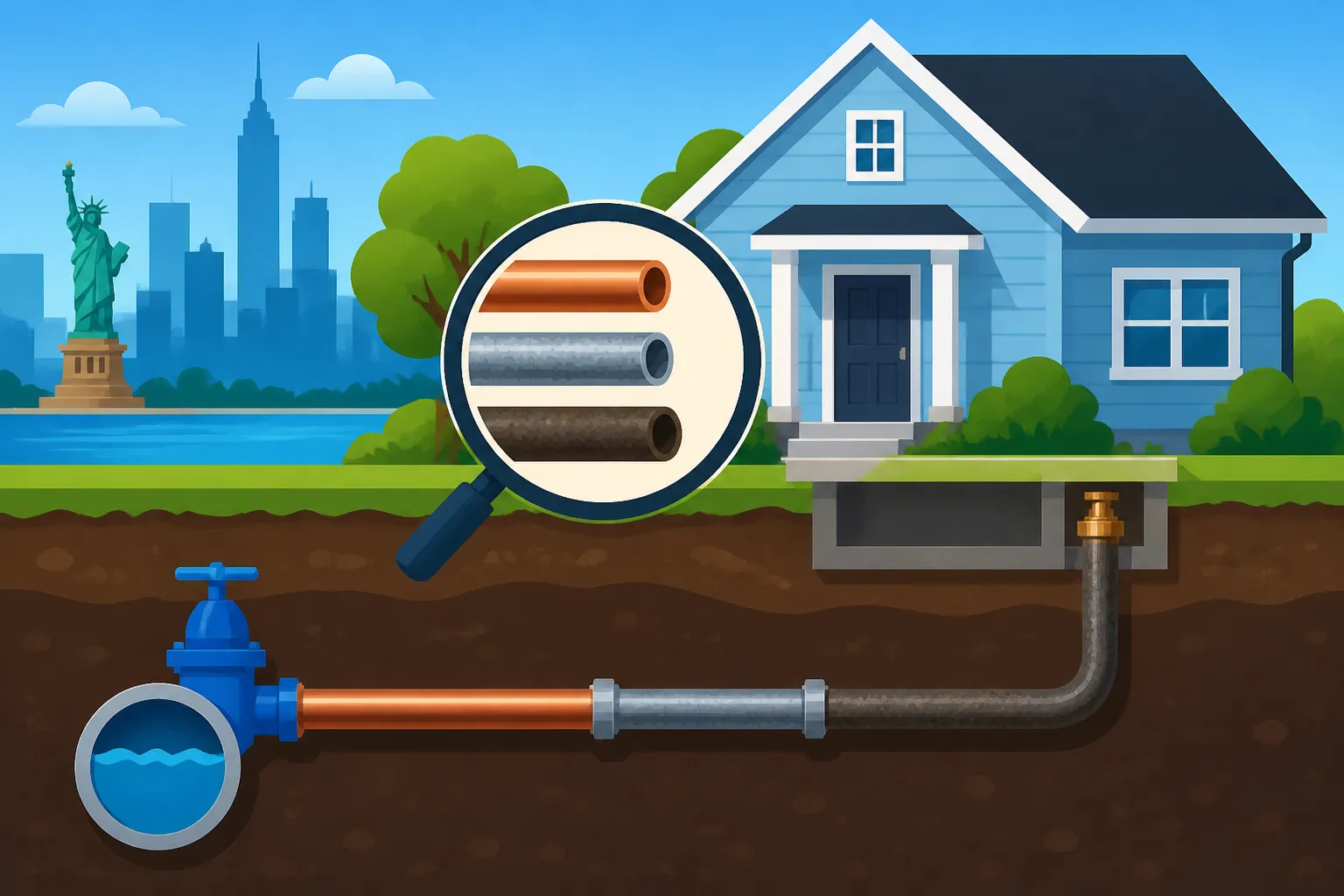
A water quality report and a service-line inventory answer different questions. A water quality report describes information about the water supplied by a system. A service-line inventory is the more relevant record when you are trying to find the material of the pipe connecting a home to the water main.
If you find a supplier’s annual water report but no service-line information, that does not necessarily mean the inventory is missing. Look for a separate inventory page or document, or ask the supplier where its public inventory can be viewed. You can also use Your Supplier’s Yearly Water Report: A New York Reader’s Guide to understand what an annual report covers and where its limits are.
Confirm the address and the supplier
Search results can be confusing when an address is near a service-area boundary, when a building has a different mailing municipality from its water provider, or when a property has changed hands. Before relying on an inventory entry, make sure you have the correct supplier and the right property identifier.
Useful details to have ready include:
- The complete service address, including apartment or unit information if relevant
- The municipality shown on your water bill or lease
- The water supplier’s name, if you already know it
- A parcel or account identifier, if it appears on a bill or property record
- The name of the property owner or account holder, if you are authorized to request records
If the search tool does not accept a street address, check whether the supplier’s inventory offers another way to search, such as a map or a downloadable record. If it still is not clear how to find the property, contact the supplier or municipality rather than guessing which nearby entry applies.
How to check your home’s entry
Start with the NYSDOH inventory and follow its information to the appropriate public water system. Then look for the system’s inventory or address lookup. The exact display can vary, so focus on confirming that you are looking at the right system and the right property—not just a similar street name.
A careful lookup is more reliable than a quick map glance. Take these steps:
- Confirm the supplier. Check a current water bill or ask the municipality if the supplier is unclear.
- Open the NYSDOH inventory. Use the NYSDOH Lead Service Line Inventory as the starting point for locating the public water system’s information.
- Find the supplier’s record or search tool. Follow the inventory’s directions, if available, to the system-specific inventory.
- Search the full address. Include the unit or building details when the tool allows it. If the address does not appear, try the format used on your water bill or property records.
- Record what the entry actually says. Note the material description, any uncertainty label, the date or record details shown, and whether the entry appears to apply to the whole service line or only a portion.
- Ask for property-specific confirmation. Contact the supplier or municipality if the record is missing, unclear, or seems inconsistent with your home’s records.
- Keep the response. Save the inventory result and any written reply so you can refer to the same information later.
The sixth step matters even if the online result appears definite. A public inventory entry may not explain how the material was identified or which pipe segment the description covers. A supplier or municipality may have additional property records, such as information from past work, inspections, or testing. Ask what evidence supports the entry and whether the available records cover the entire service line.
What to write down
When you find an entry, save a copy or screenshot for your records. Also note:
- The date you checked
- The address or parcel identifier you searched
- The name of the public water system
- The exact material wording used in the entry
- Any status indicating that the material has not been confirmed
- Any notes explaining the record or its limits
Do not translate a label into a stronger conclusion than the record supports. If the inventory uses a term you do not understand, ask the supplier to define it for that property. If a map marker appears on your street but not clearly at your address, do not assume that it identifies your home.
| What you find | What it can tell you | What to confirm |
|---|---|---|
| A clear entry for your address | The inventory contains a property-related record | Whether it covers the full service line and what records support it |
| An entry with uncertain or incomplete material information | The material is not clearly established in the record you viewed | What the supplier or municipality knows and what evidence is available |
| No entry for the address | Your search did not return a property-specific result | Whether the address format, supplier, or lookup method is correct |
| A nearby result but no clear match | The inventory includes information in the vicinity | Whether the record applies to your property or a different one |
| A result that conflicts with your paperwork | Different records may describe different work or pipe sections | Which record is current and what portion of the line each describes |
This table is a way to organize your follow-up, not a substitute for the supplier’s explanation. The inventory entry should be read as a record of what is listed, not as proof of details that it does not display.
For a fuller explanation of what a service line is and why its two sides can matter, see Lead Pipes Between the Main and Your Home: A New York Guide. If you are trying to check an address in a particular city or county, an address-specific lookup may be covered by a more local resource, such as Buffalo’s Service Line Inventory Map: A Homebuyer’s First Lookup or NYC Service Line Map and the Free Lead Test Kit: How to Use Both.
What the entry can—and cannot—tell you
A material record is useful, but its meaning depends on what was checked and how the entry is defined. Some records may provide a clear material description; others may not establish the material. If the entry is ambiguous, ask the water supplier or municipality to explain it rather than interpreting the wording on your own.
The inventory can help you start a conversation about the service line. It may not, by itself, answer all of these questions:
- Does the entry refer to the pipe from the water main to the property, the pipe on the property side, or both?
- Was the material verified at the address, or is the entry based on another kind of record?
- Is there a separate record for the portion of pipe inside the building?
- Has work been done since the information was entered?
- Are prior lead test results available for the property?
- Is the online record current, or should the supplier confirm a change?
These are reasonable questions because a service connection can involve more than one segment, and property records may describe only the part that was inspected or worked on. A home may also have plumbing inside the building that is separate from the service line. A service-line record should not be treated as a full assessment of every pipe, fixture, or other plumbing component in the home.
That distinction is especially important if you are buying, renting, or renovating. A listing may describe the service line but say nothing about indoor plumbing. Conversely, a plumbing invoice may describe work in the building without identifying the material of the line outside. Keep each record tied to the pipe section it actually covers.
If the material is unknown or the address is missing
An unknown or missing entry is not the same as a confirmed finding that the line is a particular material. It means the information you found does not settle the question. Ask the supplier or municipality whether it has property-specific service-line records, past lead results, or other information that can clarify the status.
If staff cannot confirm the material from existing records, ask what process is available to verify it and who is responsible for arranging that step. Avoid digging, cutting, or exposing a pipe yourself based only on an online map. A qualified person can explain what inspection or identification approach is appropriate for the property.
If you are a renter, you can ask the landlord or property manager for any service-line or plumbing records they have, while also confirming the supplier’s information. If the response is unclear, ask the supplier or municipality directly what it can disclose about the address. Keep copies of emails, letters, or test results so the answers do not get separated from the property details.
More on records and identification is available in Records, Inspections, Excavation: How a Lead Pipe Gets Identified and Verifying an Unknown Pipe in New York Before Deciding on a Lead Test.
If records conflict
Conflicting information does not automatically establish which record is correct. One document may describe a different section of pipe, work from a different date, or a different address format. Ask the supplier or municipality to compare the records and explain:
- Which address each record covers
- What pipe segment each record describes
- When the information was collected or updated
- What method or documentation supports the material description
- Whether there is a more recent record
If you are considering a home purchase, share the conflicting documents with the appropriate property professional and request clarification before treating the question as resolved. A service-line lookup can inform due diligence, but it is not a substitute for a property-specific review.
What to ask the supplier or municipality
Once you have checked the inventory, make a focused request. The goal is not merely to ask whether the line is “lead” or “not lead,” but to understand what the available records say and what portion of the plumbing they cover.
You can adapt this message:
I am checking the service-line material for OCWA’s Service Material Inventory Map: Checking Your Address. I reviewed the NYSDOH Lead Service Line Inventory and describe what you found, or say that you could not locate the address. Can you confirm the material recorded for this property, explain which pipe segment the record covers, and provide any property-specific service-line records and prior lead results available?
If the answer is that the record is incomplete, follow up with questions such as:
- Is the service line’s material confirmed or still uncertain?
- Does the record cover the line on both sides of the property boundary?
- Are there work records, inspection notes, or prior test results for this address?
- What should the property owner or renter do if the material cannot be confirmed from records?
- Is there a way to receive an updated response in writing?
Be precise about the address and ask for a written answer when possible. If you are a renter, explain that you are asking about the home you occupy and include the apartment or unit number. The supplier may need to identify the property from an account or parcel record, and a complete address can reduce confusion.
If you are unsure whether an answer describes the public-side line or private-side line, ask directly. A general statement about a street, block, or neighborhood may not establish the material at your specific home. The same applies to a neighbor’s test or plumbing work: it can be useful context, but it does not by itself confirm the condition of your service line.
For a larger overview of the difference between utility records and household conditions, see Does a New York Water Quality Report Describe Your Own Kitchen Tap?. For questions about how sampling is carried out by suppliers, How Lead Sampling at a Few Homes Ends Up in a New York Water Report explains why a limited set of results should not be mistaken for a direct test of every home.
When a water test is the next step
A service-line inventory check and a tap-water test provide different information. The inventory is about the recorded material of a service line. A water test measures what is in the sampled water at the time and place it was collected. One does not automatically answer the other question.
If you want to check the water at your home for lead, NYSDOH says, “Certified commercial laboratories can test for lead in drinking water.” According to NYSDOH, a certified commercial laboratory can test tap water for lead. Ask the laboratory how to collect and deliver a sample, which tap to sample, and whether its instructions require any preparation. Following the lab’s directions is important because collection choices can affect what the result represents.
A test result should be read in context. Ask the laboratory or a qualified professional what the sample represents and whether another sample or a different sampling approach would answer your question more clearly. If you receive a result that concerns you, ask the local health department or a medical professional about health-related questions, and contact the supplier about the service-line record.
Do not use a water test as proof of pipe material, and do not use a pipe-material entry as proof of a particular test result. These records and tests answer related but separate questions. If your main concern is identifying the pipe, pursue the inventory and property-specific records. If your concern is lead in water at a tap, ask a certified commercial laboratory about testing that water.
For more on choosing between those steps, read Lead Test or Service Line Check? What Each One Tells a New York Owner. If you already have a result, Reading Water Test Results in New York: Detections, Limits, Violations can help you understand how to approach the report, while Lead in New York Drinking Water: Sources, Testing and What to Do provides broader context.
Frequently Asked Questions
Does the NYSDOH inventory cover every home in New York?
NYSDOH says its inventory lists New York State public water systems for which lead service-line inventories are required by regulation or law. If you cannot find a specific property, contact its water supplier or municipality to ask whether property-specific information is available.
What if I cannot find my address?
First confirm that you have the correct supplier and are using the address format the lookup accepts. If the property still does not appear, ask the supplier or municipality to check its records for the address.
Does an unknown entry mean my service line contains lead?
Not by itself. An unknown or unclear entry means the record you viewed does not establish the material. Ask the supplier or municipality what information it has and whether it can explain the status for the property.
Will a tap-water test tell me the service-line material?
No. A tap-water test and a service-line record answer different questions. NYSDOH says, “Certified commercial laboratories can test for lead in drinking water.” Contact a certified commercial laboratory about testing, and ask the supplier or municipality about pipe-material records.
Sources
- New York State Department of Health — Lead Service Line Inventory (checked November 13, 2026)
- New York State Department of Health — Summary of Lead Service Line Inventory – Newburgh City (NY3503549) (checked November 13, 2026)
Disclaimer
This article is for general informational purposes only and does not constitute professional advice. Laws, prices and regulations vary by location and change over time. Consult a qualified professional for guidance on your specific situation. New York Water Guide is not a government agency or water utility and is not affiliated with any public water system.