Reservoir, River or Groundwater: Sources for Upstate New York Towns
If you live in an upstate New York town, the water at your tap may begin in a reservoir, river, lake, or underground aquifer—and the answer can differ from one nearby address to another. Knowing the source helps you understand your supplier’s water report, investigate a change in taste, and find out what local information can and cannot tell you about your own tap.
The main water sources serving upstate towns
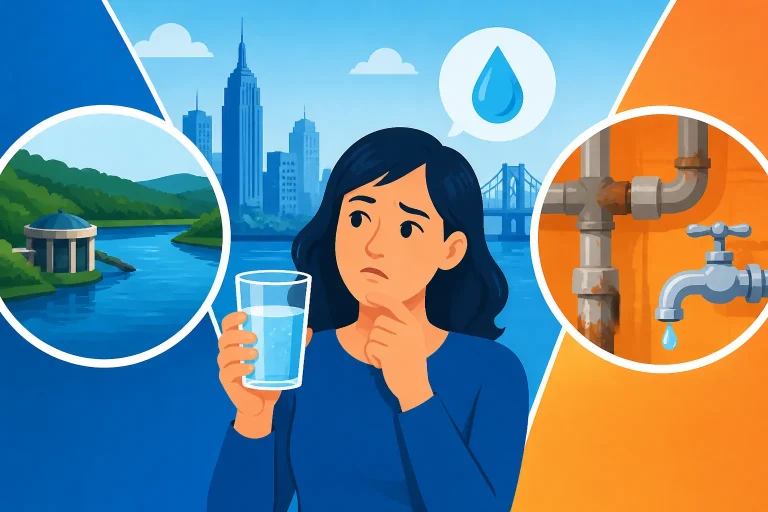
A public water supply starts with a source: water collected from surface waters such as lakes, rivers, and reservoirs, or pumped from groundwater beneath the land. Some systems rely mainly on one source; others may use more than one, or receive water from another supplier. The source is only the beginning of the route to your faucet. Treatment, storage, and the pipes serving a neighborhood also shape the water people receive.
Surface water: reservoirs, lakes, and rivers
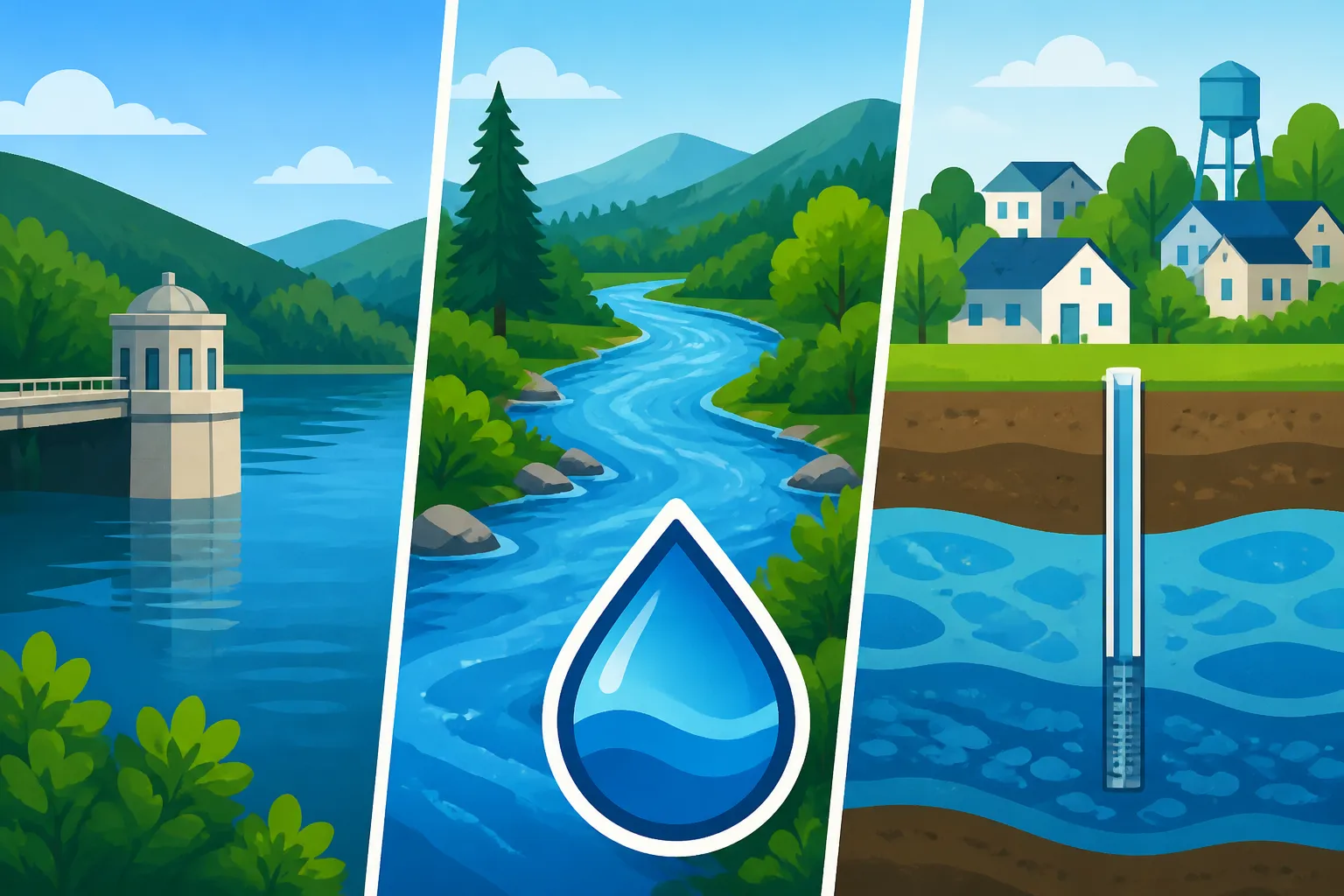
Surface water is water in rivers, lakes, and reservoirs. A utility may collect it directly from a lake or river, or draw from a reservoir designed to store water for use. The water can come from a watershed that extends beyond the town receiving it. Rain and snowmelt, streams, and other flows can contribute to the water in that area.
Surface water is exposed to conditions across its watershed. Runoff from land, seasonal changes, and natural organic material can affect the source before it reaches a treatment plant. That does not mean a surface-water source is unsafe. It means the supplier has to manage water drawn from an open environment, treat it as needed, and monitor the supply under applicable requirements.
The word “reservoir” can also be misleading if taken to mean that all water in a system comes from a single, isolated lake. A reservoir may be part of a larger network of lakes, streams, intake structures, and pipes. A supplier may also change how it uses available sources. The name of a town, watershed, or nearby lake is not enough to establish which source supplies a particular home.
To understand a specific area, first identify the supplier. Then look for its water quality report and any source-water information it provides. If the report describes a surface-water source, check whether it identifies a lake, reservoir, river, or more than one source. For a broader overview of the region’s sources, see Where New York’s Tap Water Comes From: Reservoirs, Lakes and Aquifers and How to Find Out Where Your Upstate New York Town’s Water Comes From.
Groundwater: water drawn from wells
Groundwater is held in spaces in soil, gravel, or rock beneath the ground. A public water system that uses it generally draws water through one or more wells. It may be called a well supply even though the water is delivered to many homes through a public distribution system.
The depth, geology, and local conditions around a well influence the characteristics of groundwater. Water from one well may differ from water drawn from another well, even when both serve nearby places. Groundwater can contain naturally occurring minerals, and activities at the land surface can affect it if contaminants reach the aquifer. The supplier’s treatment and monitoring are part of how it manages those source-water conditions.
Groundwater is an important source beyond upstate New York. The New York State Department of Environmental Conservation says groundwater provides drinking water to one quarter of New Yorkers, and half of all Americans. That statewide fact does not tell you whether your particular town uses groundwater; the local supplier’s information is needed for that.
A town’s name, rural setting, or proximity to a well does not prove that a home gets groundwater. A public system can serve a community using a source located outside its boundaries, and a system may purchase treated water from another supplier. Conversely, a home that appears to be in a town with public water may instead use a private well. Check the water bill, ask the property owner or supplier, or use Moving In? Find the Supplier and Water Report for a New York Address to work out which system serves the address.
A system may use more than one source
Some suppliers can draw from more than one source or change which source they use as conditions and operating needs change. A report may describe a primary source, a backup source, or a combination. If the wording is unclear, ask the supplier whether the listed source is the only one used, whether sources are blended, and whether the source can vary by season or operating conditions.
A town’s water may also come from a supplier outside the immediate community. In that case, the town or local authority may handle billing or distribution while another system produces the water. Knowing who sends the bill is useful, but it does not always identify who treats the water or where the water originated. The best next step is to check the supplier listed on the bill and ask whether it buys water from another system.
The distinction matters when you read a water quality report. A report may cover water from a treatment plant or system rather than sampling every home. If water changes hands between suppliers, the report may describe the system producing it, while local plumbing and storage affect what reaches your faucet. Does a New York Water Quality Report Describe Your Own Kitchen Tap? explains why a system-level report and a household tap result are not the same thing.
| Source or arrangement | What it means | What to check |
|---|---|---|
| Reservoir, lake, or river | Water is collected from surface water | The named source, treatment information, and whether more than one surface source is used |
| Groundwater well | Water is drawn from an underground source | Which wells or aquifers serve the system and whether the supplier describes treatment |
| Multiple sources | The supplier may use or combine more than one source | Whether use varies, and which source supplied the system during the period covered by a report |
| Purchased water | Another system may treat or supply the water | Which supplier produces the water and which report covers it |
| Private well | The property has its own water source rather than a public supplier | Whether the well is tested and maintained; public-system reports do not describe a private well |
The table is a starting point, not a way to identify a source from a town name. A supplier’s records are more reliable than assumptions based on what is nearby.
How water travels from its source to your tap
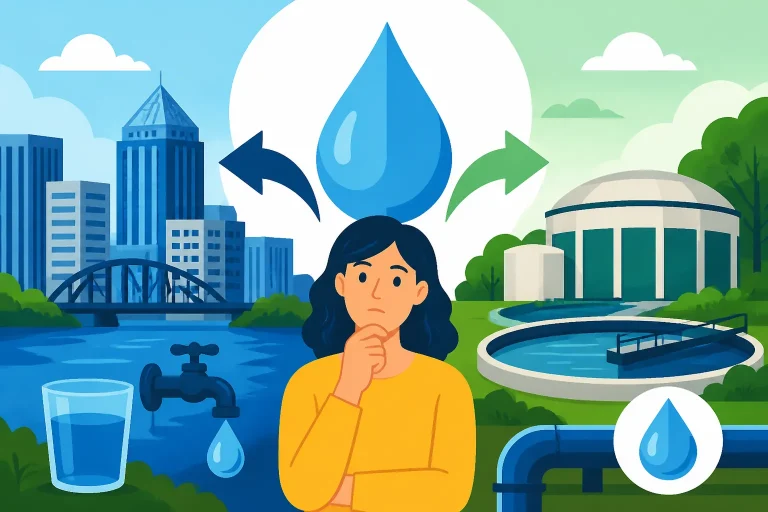
Knowing the source answers only one part of the question. Drinking water usually travels through a sequence of steps between the source and the household. The precise setup varies by supplier, but the general path may include an intake or well, treatment, storage, and a distribution network. The water can then pass through the service line and a building’s plumbing before it reaches a faucet.
Collection and treatment
For a surface-water supply, a system collects water from its source. For groundwater, the system pumps water from wells. The supplier then manages and treats the water as needed for its source and operating requirements. Treatment can differ between systems, so it is better to use the supplier’s report than to assume that every town uses the same process.
Treatment may address characteristics of the source water, but it does not make every source identical or guarantee that water will have the same taste everywhere. Water chemistry can affect taste and odor, and treatment choices can also influence what customers notice. If you have a new or persistent taste, odor, or color concern, compare notes with neighbors and contact the supplier if the change seems unusual. Taste, Odor and Color Problems in New York Tap Water and Supply or Plumbing? Tracing a Sudden Taste Change in New York Water offer ways to think through where a change might be coming from.
A source description is not a household test result. The fact that a supplier uses a lake, reservoir, river, or well does not, by itself, establish whether water at a particular faucet has a problem. If a concern is specific to one home or building, plumbing, a storage tank, or a service line may be relevant. Kitchen Tap vs. the Utility Report: What a New York Report Can’t Show explains this difference.
Storage and distribution
After treatment, water may be stored and sent through pipes to customers. The distribution system connects the supplier’s facilities to streets and buildings. The condition and layout of that network can matter when there is a repair, water-main work, or a pressure change. It is one reason a sudden change in water appearance may be limited to one area rather than reflecting a change in the source itself.
The property’s own plumbing is another part of the route. Water can spend time in a service line, building pipes, fixtures, or a storage tank before it reaches a tap. A report about the supplier’s treated water cannot describe every pipe inside every building. For questions involving lead, a service-line record and a tap sample answer different questions; see Lead Test or Service Line Check? What Each One Tells a New York Owner.
Source is not the same as supplier
People often use “the town’s water” to mean several different things: the source, the organization that treats the water, the system that distributes it, or the utility that sends the bill. Those roles can be held by different organizations. A municipality may not own the source or treatment plant, and a supplier may serve customers across municipal boundaries.
This distinction matters when you need a report, want to ask about a source, or need help with a water problem. Start with the name on the water bill or the official supplier information for the property. If the listed organization does not produce the water, ask which system does. Finding Your New York Water Supplier and Whether It Adds Fluoride can help with the supplier-identification question, while City Water or the County Authority? Clues on Your Water Bill focuses on clues in billing records.
How to find the source for your address
The most reliable approach is to identify the supplier first and then confirm the source using the supplier’s own report or source-water information. Do not rely on a town boundary, a nearby river, or a neighbor’s well to identify what comes out of your faucet. Two homes close together can be served differently.
Use this process:
- Check your water bill or lease information. Note the name of the water supplier, not just the municipality or company handling payment. If you rent, ask the landlord or building manager which supplier serves the property.
- Confirm the service address. A town may have more than one water system, and neighboring areas may be served by different suppliers. If you are unsure, use Border Streets, Two Suppliers: Finding Which One Bills Your Address.
- Find the supplier’s water quality report. Look for the description of the source and the system covered by the report. If the report is not clear about the source, ask the supplier.
- Check for purchased or blended water. Ask whether the supplier treats water itself, receives water from another system, uses multiple sources, or changes sources under particular conditions.
- Ask what the source information applies to. Confirm that the report covers your address and the relevant system, rather than a nearby community or another part of the supplier’s service area.
- Keep the report separate from a tap test. A supplier report describes the public system within its stated scope. If you need to know what is present at your own faucet, the right next step may be a household sample or a plumbing investigation.
The New York State Department of Health says Every major water supply has a Source Water Assessment Plan that maps water from its source to the tap. A source assessment helps explain the area and pathways that may affect a supply; it is not the same as a test of water collected at your kitchen faucet. Look for the assessment through the supplier or ask where customers can review it.
If you cannot find a report online, ask the supplier how to obtain it. If the report names a source but does not say whether it is currently in use, ask directly. Useful questions include: Does this system use surface water, groundwater, or both? Does it purchase water from another supplier? Can the source change? Which report covers this address? Is the source assessment available for review?
For additional help interpreting a supplier’s report, see Your Supplier’s Yearly Water Report: A New York Reader’s Guide and How to Read the Result Columns in a New York Water Quality Report. The source description gives context, while the report’s results and explanations tell you what the supplier is reporting for the system.
What the source can—and cannot—tell you
The source can help you understand the water system’s starting point. It can point you toward the right supplier, report, and source assessment. It can also provide context if you notice a change or want to understand why a system treats its water in a particular way. But the source name alone is not a complete answer to whether your water is suitable for a particular use or whether a household problem exists.
A surface-water source is not automatically worse than groundwater, and groundwater is not automatically free of contaminants. Each source has its own conditions. The supplier’s treatment, monitoring, system operation, and the plumbing serving a property all contribute to the overall picture. A lake, river, or reservoir can be managed as part of a public supply; groundwater can contain substances that need attention. The useful comparison is not simply “surface versus underground,” but what the supplier reports about the specific system and what testing shows at the point of concern.
Likewise, a source-water assessment is not a guarantee that every possible contaminant has been ruled out. It describes source areas and potential pathways, while monitoring and water quality reports provide other information. A household sample can answer a different question, especially when a concern may come from a building’s pipes or fixtures. If the issue may involve lead, consult Lead Pipes Between the Main and Your Home: A New York Guide and How to Look Up Your Home’s Service Line Material in New York.
A source change or a difference in water characteristics does not automatically mean there is an emergency. If an official notice has been issued, follow the instructions from the supplier or health authority. If there is no notice but water has a sudden, persistent change, contact the supplier and ask whether there is work or an operating change that could explain it. For an unusual taste, smell, or color that seems limited to your home, ask whether a household plumbing issue may be involved. Neighbors Taste It Too? When to Call Your New York Water Supplier covers how a shared pattern can help guide that conversation.
The practical takeaway is to treat source information as a map, not a verdict. It tells you where to begin looking and which system to ask. It does not replace the supplier’s current report, a relevant notice, or a test designed for your specific concern.
Frequently Asked Questions
Can I tell my water source by looking at a map?
A map may show nearby lakes, rivers, or reservoirs, but proximity does not establish which source supplies your address. Confirm the supplier and check its report or source-water information.
Does groundwater mean my home has a private well?
No. A public water system can draw groundwater from wells and distribute it to many customers. Check whether your property is connected to a public system or uses a private well.
Can a town use both surface water and groundwater?
A supplier may use more than one source, but arrangements vary. Ask the supplier whether it uses or blends sources and whether use can change.
Does a Source Water Assessment Plan test my kitchen tap?
No. The New York State Department of Health describes the plans as mapping water from its source to the tap. A household sample is a separate way to investigate what is present at a specific faucet.
Sources
- New York State Department of Environmental Conservation — Waterbodies – NYSDEC (checked November 13, 2026)
- New York State Department of Health — New York’s Public Water Systems (checked November 13, 2026)
Disclaimer
This article is for general informational purposes only and does not constitute professional advice. Laws, prices and regulations vary by location and change over time. Consult a qualified professional for guidance on your specific situation. New York Water Guide is not a government agency or water utility and is not affiliated with any public water system.